Summary: This blog explores the architectural shift in digital authentication from traditional passwords (“what you know”) to biometric verification (“who you are”). It explains that while passwords fail by design due to human limitations, shared secrets, and vulnerable databases, biometrics offer a more robust solution by binding identity to unique, unforgeable physical or behavioral traits.
The core problem with proving who you are
Every authentication system is trying to solve one problem: how do you prove, across a network, that the person making a request is who they claim to be? For most of the internet’s history, the answer has been a shared secret. You and a server both know a password, and matching it is treated as proof of identity. The logic is straightforward and has worked well for decades. Yet, it has always carried a structural flaw.
A password can be stolen without anyone knowing it is gone. A fingerprint cannot. That single difference is what makes the move from passwords to biometrics significant. Additionally, biometric verifications are fast and more convenient.
The three factors of authentication
Security practitioners organise authentication evidence into three categories:
| Factor | What it relies on |
|---|---|
| Something you know | Passwords, PINs, security questions. The weakest category: knowledge can be shared, guessed, or stolen. |
| Something you have | A phone, a hardware token, a smart card. Stronger, but still losable or cloneable. |
| Something you are | A fingerprint, a face, an iris, a voice pattern. Bound to a physical person and very difficult to transfer. |
The “something you know” category carries an inherent vulnerability: once a password leaves your memory, through a breach, a phishing page, or an intercepted transmission, it stops being proof of identity. Biometrics sit in the third category. They cannot be emailed to an attacker or typed into a fake login form.
Why passwords fail by design, not by accident
The deeper issue with passwords is not that people choose weak ones. It is that a password is a shared secret between you and a server. Two parties hold it, and both are potential points of failure.
When a service stores your password, it stores a hashed version. If that database is exposed, attackers can attempt to reverse common passwords through dictionary and brute-force methods. If the password is transmitted over a compromised connection it can be intercepted. If the user is sent to a convincing fake login page, it is handed over directly. Complexity does not fix any of these attack paths because they exploit the architecture, not the password itself.
There is also the sheer volume problem. Think about how many accounts you personally have: email, banking, shopping, work tools, subscriptions, utilities. Each one wants a unique password. Most people reuse the same few passwords across many of these simply because there is no realistic alternative. That is not poor security hygiene. That is a normal human response to an unreasonable ask.
What biometrics actually are: the first principles
Biometric authentication verifies identity through measurable biological or behavioural characteristics unique to an individual. The critical property is that they are bound to a physical person. They cannot be memorised or forwarded.
The characteristics used fall into two groups:
- Physiological biometrics measure physical attributes: fingerprint ridge patterns, facial geometry, iris structure, and hand vein maps.
- Behavioural biometrics measure patterns in how someone acts: typing rhythm, gait, mouse movement, and touchscreen pressure.
For a biometric to be useful in authentication it needs three properties: it must be present in every individual (universality), it must differ sufficiently between people (distinctiveness), and it must remain stable enough over time (permanence). Iris patterns, for example, score highly on all three. Security questions score poorly on all three, which is why they are no longer recommended by standards bodies including NIST in the United States.
How a biometric system actually works
A biometric system has two stages: enrolment and verification.
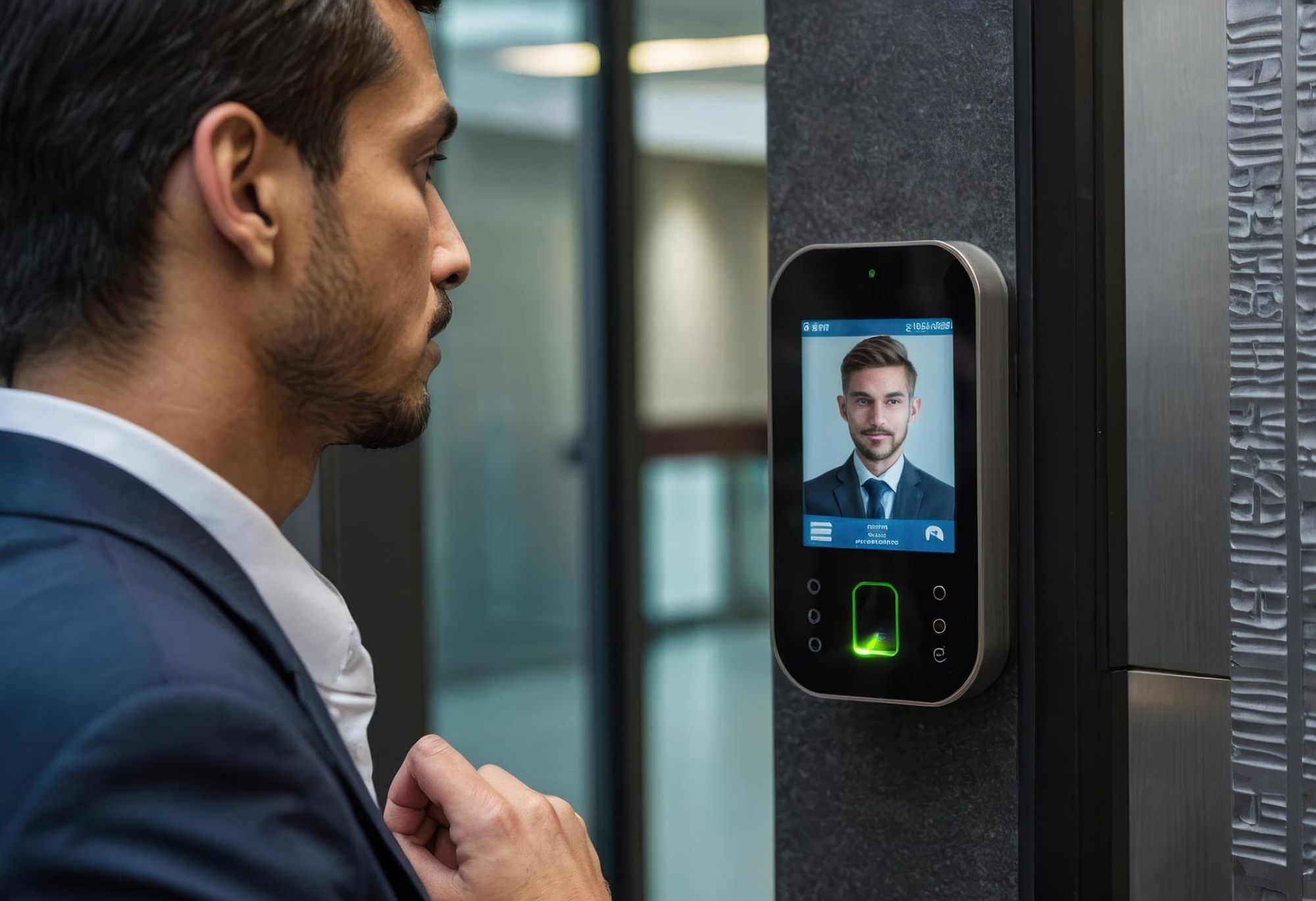
During enrolment, the system captures a sample, extracts a mathematical template from it, and stores that template. What is stored is not a photograph or a recording. It is an abstracted numerical representation of specific features. On modern devices like Apple’s Face ID, this template is stored in a dedicated hardware component called the Secure Enclave, which is isolated from the main processor and never transmitted to external servers.
During verification, a new sample is captured, a fresh template is extracted, and the two are compared by a matching algorithm. The algorithm produces a match score. If that score clears a defined threshold, access is granted.
This architecture has a direct security implication: the biometric never leaves the device. The server receives a signed cryptographic assertion, not raw biometric data. There is nothing for an attacker to intercept that would let them replay the authentication.
The honest tradeoffs
Biometrics are not a perfect solution. They still do not solve security problems completely.
The irrevocability problem
A compromised password can be changed. A fingerprint cannot. This shifts the critical security surface from the biometric itself to the template stored by the system. A provider that stores raw biometric data rather than abstracted templates creates a much more serious breach risk. Before adopting any biometric system, the key question is not how the biometric is captured but how the template is stored and protected.
False acceptance and false rejection
No biometric system is perfectly accurate. A false acceptance is when the wrong person is granted access. A false rejection is when the right person is turned away. Designers must choose a threshold that balances these two error types for the risk level of their application. High-security systems accept more false rejections in exchange for a lower false acceptance rate.
Liveness and spoofing
A fingerprint scanner that cannot tell a live finger from a silicone replica is not a biometric system in any meaningful sense. Liveness detection, confirming that the biometric comes from a physically present, living person, is a necessary component of any serious deployment. Without it, a captured image or recording may be sufficient to bypass authentication.
The AI deepfake problem: a new class of spoofing threat
Earlier spoofing attempts required physical props: a printed photo, a silicone mould, or a pre-recorded video clip. These were detectable with relatively simple liveness checks such as asking the user to blink or turn their head. AI-generated face and voice synthesis has changed this. It can now produce real-time output that responds dynamically to prompts, moves naturally, and is constructed from nothing more than publicly available images and audio. A liveness check designed to defeat a static photograph offers no meaningful protection against a generative model that produces a live, responsive face on demand.
What biometric systems now need to do
Effective liveness detection today must go beyond passive observation of movement. It needs to incorporate injection attack detection (identifying when a synthetic video feed is being piped into the camera input rather than captured live), analysis of physiological signals such as micro-texture and subtle colour changes in skin that generative models currently struggle to replicate consistently, and behavioural anomaly signals that flag interactions that look real but do not behave like a genuine person in front of a camera. Biometric authentication systems that have not been updated to account for AI-generated spoofing carry a meaningful and growing gap in their security posture.
The direction this is heading: passkeys and FIDO2
The most architecturally sound direction is not biometrics replacing passwords directly, but biometrics unlocking a cryptographic key that does the authentication. This is the model behind FIDO2 and passkeys, now supported by Apple, Google, and Microsoft.
A passkey is a cryptographic key pair. The private key never leaves the device. Logging into a service means signing a challenge with that key. The server stores only the public key. There is no shared secret to steal. Biometrics are used locally to unlock the private key. The server never sees the biometric, and the biometric never travels across a network.
Closing summary
The move from passwords to biometrics is a structural change in the logic of authentication, not just a usability improvement. Passwords rely on secrecy. Biometrics, when properly implemented within a cryptographic framework, rely on physical presence and unforgeable proof. The security question shifts from “can this secret be stolen?” to “can this person be convincingly replicated in real time?”. That is a harder problem for attackers to solve. It is also, finally, a foundation that does not ask users to behave like machines in order to stay secure.