Summary: AI-powered facial recognition is transforming security from a reactive system that records incidents to a proactive system that identifies and responds to potential threats in real time. As security challenges grow across industries such as airports, healthcare, banking, retail, and corporate facilities, organizations are adopting facial recognition to handle the massive scale of daily identity verification that humans alone cannot manage efficiently. Reflecting this trend, the global facial recognition market is expected to reach USD 20.68 billion by 2031, growing at a CAGR of 15.6%, driven by increasing demand for surveillance, identity authentication, and fraud prevention.
Security has always been a race between threat and response. For decades, that race was won with passwords, locks, guards, and cameras that recorded what happened, after it happened. Today, AI-powered facial recognition is shifting the equation entirely, from reactive documentation to proactive identification.
The numbers speak to how seriously industries are taking this shift. According to MarketsandMarkets’ Facial Recognition Market — Global Forecast to 2031 (May 2026), the global market is projected to reach USD 20.68 billion by 2031, growing at a CAGR of 15.6% between 2026 and 2031, driven by rising demand for robust surveillance, identity authentication, and fraud prevention across sectors.
The case for adoption is not simply about doing things faster or more accurately. It is about volume. Modern security environments demand millions of identity verifications every single day: at border crossings, hospital entrances, ATMs, airport gates, retail stores, and corporate campuses simultaneously. No human workforce can operate at that scale, with that consistency, around the clock. AI-powered facial recognition is not a convenience; it is the only architecture capable of meeting that demand.
Here are five sectors leading the AI-Powered Surveillance transformation.
1. Law Enforcement & Public Safety: Securing Crowds, Cities, and the Unreachable
Large-scale public events (concerts, sporting finals, religious gatherings) represent one of the most complex security challenges in existence. Tens of thousands of individuals move through controlled spaces, often with limited checkpoint opportunities and enormous pressure to maintain flow.
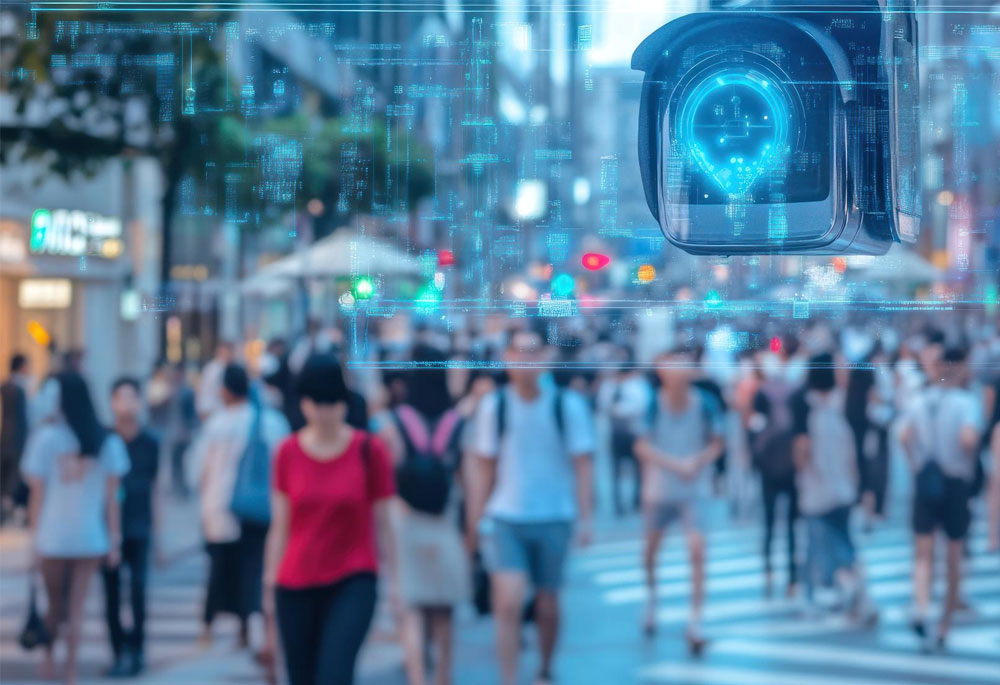
AI-powered facial recognition changes the calculus. Integrated with CCTV networks, it enables security teams to cross-reference faces in a crowd against watchlists of known offenders, banned individuals, or persons of interest, in real time, without disrupting the event experience. Rather than waiting for an incident to unfold, operators receive an alert the moment a flagged individual enters the perimeter.
The same logic scales to everyday urban life. Major cities are deploying facial recognition across public transit networks, high-footfall commercial districts, and open plazas, creating a continuous, ambient layer of public safety that human patrols alone cannot replicate. For law enforcement agencies managing thousands of square kilometres of urban space with finite personnel, AI surveillance acts as an always-on force multiplier.
It extends further still, into environments where human presence is simply not viable. Border crossings in remote terrain, critical infrastructure sites (power stations, water treatment facilities, communications towers) and vast industrial perimeters can now be monitored continuously. When a face is detected in a restricted zone, the system flags it instantly, regardless of whether a guard is present or whether the location is a hundred kilometres from the nearest city.
Counter-terrorism is where the stakes are highest. Intelligence agencies and law enforcement increasingly utilize facial recognition to track known or suspected individuals across multiple locations, connecting sightings that manual review would never link fast enough to prevent an incident. The ability to identify a person of interest in a train station, an airport, or a public square (within seconds of their entering the frame) is not a theoretical capability. It is operational in multiple countries today.
Security and surveillance has been identified as one of the fastest-growing application segments in several forecasts. This is a clear signal of where law enforcement and public safety investment is decisively heading.
2. Banking & Financial Services: Securing Every Layer, From Onboarding to Enterprise
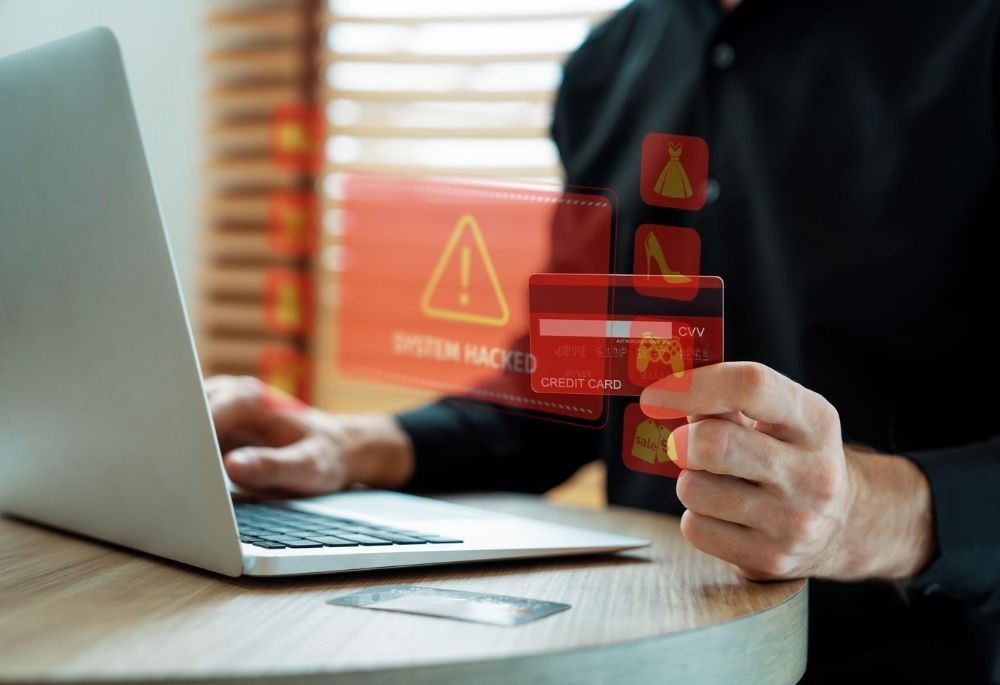
The financial sector has long battled identity fraud at branches, ATMs, online transactions, and during digital onboarding. Traditional authentication (PINs, passwords, security questions) is increasingly vulnerable to phishing, social engineering, and credential theft.
Facial recognition offers something passwords cannot: a biometric that cannot be guessed, shared, or stolen without the person being physically present. But its role in financial services now extends well beyond account opening. Every step in the financial transaction lifecycle is a potential point of attack, and facial recognition is being deployed across all of them.
At the ATM, liveness detection prevents photo or video spoofing by confirming the person presenting their face is physically present and alive. On banking websites and mobile platforms, biometric authentication replaces passwords for login and step-up verification on high-value transfers; the user simply looks at their camera to authorise a transaction. This removes the risk of stolen credentials entirely from the authentication equation.
Inside financial institutions, enterprise communications and internal systems present an often-overlooked attack surface. Sensitive trading platforms, treasury systems, and executive communications require assurance that the person accessing them is who they claim to be. Facial recognition used as a continuous authentication layer, periodically confirming the user’s identity during a session, closes the gap that static login credentials leave open.
MarketsandMarkets in its US Facial Recognition Market report (May 2026) highlights biometrics identity as accounting for the largest market share during the 2025-2030 forecast period. This is especially driven by rising occurrences of identity theft and fraud especially in sectors like financial services, where the cost of a single breach routinely runs into millions.
3. Transportation & Aviation Hubs: Frictionless and Secure, at Scale
Airports and transit hubs face an almost paradoxical challenge: process enormous volumes of passengers as quickly as possible while identifying those who pose a risk. Every second of delay multiplies across thousands of passengers; every missed identification has potentially serious consequences.
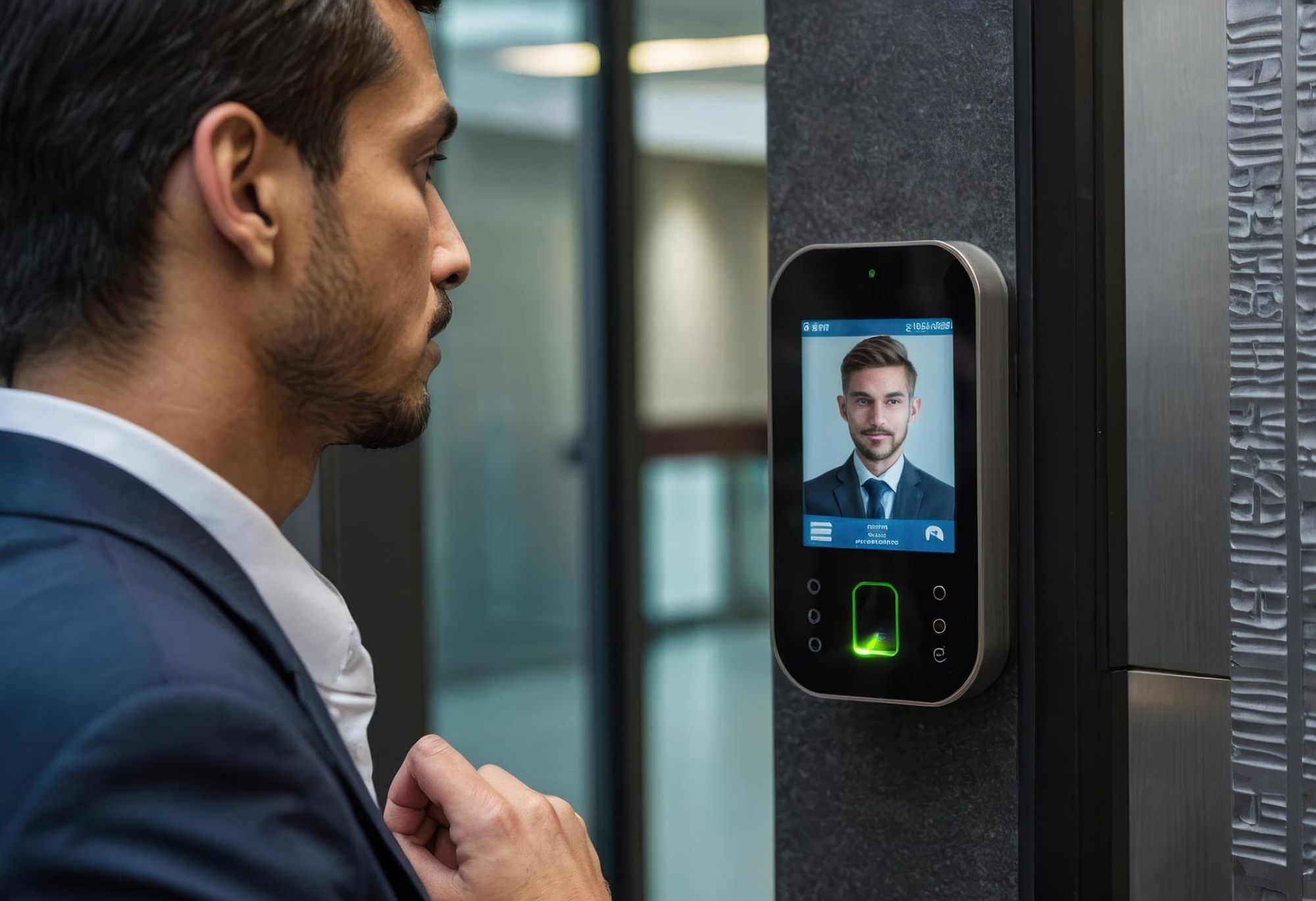
Biometric e-gates powered by facial recognition are now deployed at major international airports across Europe, the Middle East, and Asia-Pacific. Passengers pass through by presenting their face, matched against passport chip data, without touching a screen or handing over a document. Staff access to secure zones is managed by the same technology.
Several reports identify airports and critical infrastructure as primary deployment environment. The technology when used in high-security locations like airports can significantly enhance security procedures and reduce processing time.
4. Healthcare & Patient Monitoring: Identity Precision Where Errors Cost Lives
In healthcare, misidentification is not an inconvenience; it can be fatal. Wrong medication, wrong procedure, wrong patient. At the same time, hospitals must manage access to pharmaceutical stores, neonatal units, surgical theatres, and patient records, all while maintaining a care-first environment where staff move rapidly and access cannot be slowed.
Facial recognition addresses both challenges. Patient re-identification at the point of care ensures that the right person receives the right treatment. Access control to restricted areas, enforced biometrically rather than by badge, eliminates the risk of stolen or shared credentials. Visitor management systems can flag individuals with restraining orders against patients without requiring staff to make that judgment call manually.
5. Retail & Manufacturing Enterprises: Protecting Margins and Assets
Organised retail crime costs the global retail sector tens of billions of dollars annually. Manufacturing environments face a different but related challenge: protecting intellectual property, controlled materials, and production floor access from both external and insider threats.
In retail, facial recognition enables the quiet flagging of known repeat offenders the moment they enter a store, before any theft occurs. In manufacturing, it governs zone-by-zone access across large facilities where badge-based systems are regularly defeated by tailgating or credential sharing.
Grand View Research’s Facial Recognition Market Size Report notes that the retail and e-commerce segment held the largest end-use revenue share at 21.4% in 2022, reflecting the scale of enterprise investment in loss prevention and customer analytics applications.
The Road Ahead: Accuracy, Ethics, and Accountability
The technology is powerful, and the responsibility that comes with it is proportionate. Concerns around accuracy disparities across demographic groups, data privacy, and surveillance overreach are legitimate and actively being addressed through legislation in various parts of the world. Responsible deployment means pairing capability with governance: clear policies on data retention, regular algorithmic audits, and transparency with those being monitored.
What is not in question is the trajectory. Insight Partners’ Global Facial Recognition Market Forecast (2031) tracks the market growing from USD 6.53 billion in 2023 to a projected USD 18.87 billion by 2031 at a 14.2% CAGR, a near tripling in value under a decade. AI-powered facial recognition has moved from pilot programme to permanent infrastructure.
The industries investing now are not just buying technology. They are defining what secure, intelligent environments look like for the decade ahead.
Want to explore how facial recognition fits your sector’s specific security architecture? Let’s talk.