Summary:Artificial intelligence is being used to orchestrate advanced deepfake attacks against enterprises through facial manipulation, voice cloning, synthetic identities, and fake documentation. It highlights major risk areas—such as high-pressure video impersonation for unauthorized wire transfers and bypassing onboarding verification systems—and notes that these attacks are increasingly difficult to catch because they mimic legitimate behavioral and biometric signals.
In 2024, a finance employee at a Hong Kong multinational approved a $25 million wire transfer. He had joined a video call, recognised the CFO’s face, heard his voice, and followed his instructions. Every signal said it was real.
No firewall was breached. No password was stolen. The attacker built a convincing enough person, and the enterprise had no way to doubt it.
Deepfake attacks arrive through different channels, exploit different systems, and require different countermeasures. Here is how to identify each one, and how to stop it.
What exactly are deepfakes?
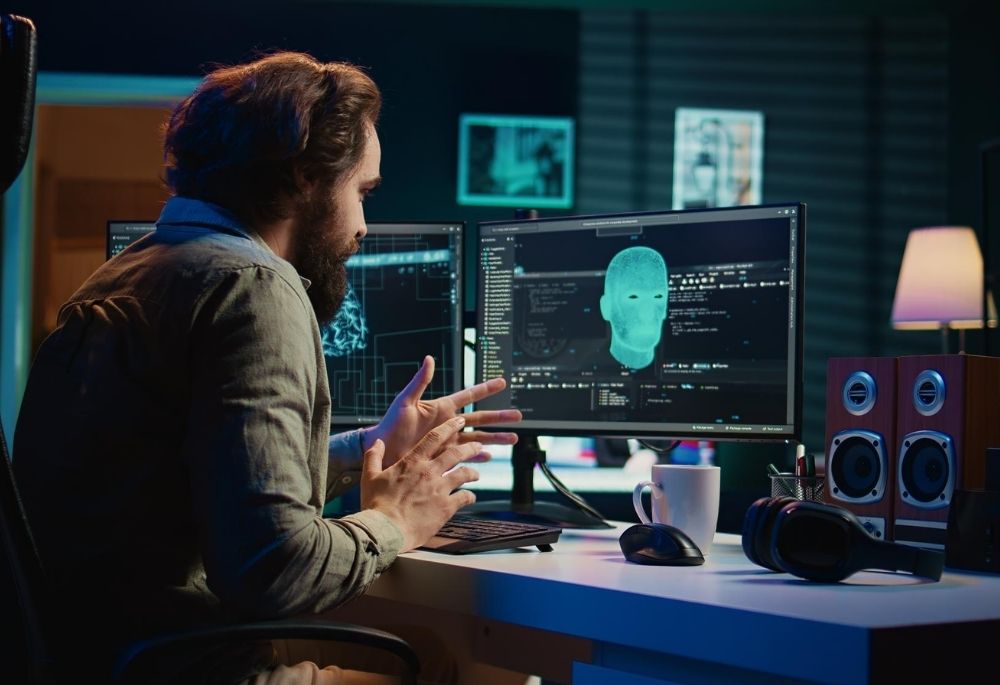
A deepfake is any media, a face, a voice, a document, or an entire identity, artificially generated or manipulated by AI to appear genuine.
In the enterprise context deepfakes as attack surfaces take four main forms.
| # | Deepfake type | How it is used |
|---|---|---|
| 1 | Facial deepfakes | AI-generated or face-swapped images and videos used to impersonate individuals in video calls, KYC checks, or onboarding sessions |
| 2 | Voice deepfakes | Cloned audio replicating a person’s tone, cadence, and speech patterns to authorise transactions or issue fraudulent instructions |
| 3 | Synthetic identities | Fabricated profiles combining genuine identity data with AI-generated biometric inputs to pass document and facial verification |
| 4 | Fake documentation | AI-generated IDs, invoices, and certificates designed to pass optical character recognition and visual inspection |
These attacks do not tamper with credentials. They bypass the question entirely by presenting a face, voice, or document that appears to belong to the right person.
How does deepfake technology work?
The technology is not one tool; it is a sequence of steps: raw data is collected, a generative AI model is trained on that data, and the output is refined until it passes detection. Each step has become faster, cheaper, and more accessible over the past three years.
Generative AI produces synthetic media; detection technologies evaluate whether it is identifiable as fake. The generative side keeps refining its output until detection can no longer reliably tell the difference.
| AI generation tools | Authentication + authorisation solutions |
|---|---|
| Ingests facial images, voice recordings, and identity documents from public sources to build a target-specific model. | Validates that the individual presenting credentials matches the identity on record using biometric matching and liveness detection. |
| Produces face-swapped video, cloned voice audio, and fabricated identity documents replicating a real person. | Checks whether the biometric input is from a live, physically present human rather than a replay or AI-generated substitute. |
| mproves continuously as it trains against current detection methods — each iteration closes the gaps the previous one left. | Converges toward higher accuracy by combining passive background analysis with active challenge-response prompts. |
Deepfake attacks in the enterprise: what are the risk areas?
Deepfakes do not arrive the way traditional cyberattacks do. No malware to quarantine, no intrusion to log. They arrive as a familiar face on a video call, a trusted voice on the phone, or a clean set of documents in an onboarding queue.
Risk area 1 — Video impersonation in financial authorisation
A threat actor generates a real-time face-swapped video call impersonating a known executive and instructs an employee to approve a transfer, release funds, or bypass a verification step. The employee sees a familiar face, hears a familiar voice, and has no visual signal that anything is wrong.
Wire transfer approvals and emergency fund releases are scenarios where urgency is normal — deepfake attackers engineer exactly that context.
| How criminals exploit this |
|---|
| Conduct open-source reconnaissance — studying executive LinkedIn profiles, earnings call recordings, and media appearances — to gather the facial and voice data needed to build a convincing deepfake model |
| Initiate a real-time face-swapped video call impersonating the executive, engineered around a high-pressure scenario such as a confidential acquisition or emergency fund release |
| Spoof the executive’s caller ID or corporate email in parallel with the video call, ensuring any employee cross-check stays within the attacker’s controlled channel |
Risk area 2 — Deepfake-assisted identity fraud at onboarding
Customer and employee onboarding is the point at which enterprises make their first identity determination — and a point that deepfake attacks specifically target. The standard verification stack involves a government-issued document, a selfie or live video check, and a match between the two. Each element can now be synthetically generated.
A fabricated identity that passes onboarding does not trigger anomaly detection, because there is no prior record of legitimate behaviour to deviate from.
Risk area 3 — Voice cloning targeting operational authority
Voice-based attacks target the instructions layer of enterprise operations — phone calls, voice messages, and verbal authorisations that sit outside formal document trails. An attacker clones the voice of a known authority figure and uses it to issue instructions employees are trained to act on.
Voice deepfakes also extend to automated systems: any enterprise using voice biometrics for call centre access or IVR-based authorisation is exposed at a system level, not just a human one.
| How the scam unfolds |
|---|
| The attacker harvests voice samples from publicly available recordings — earnings calls, conference presentations, or media interviews — and uses AI voice cloning tools to replicate the target’s tone, cadence, and speech patterns odel |
| The attacker places a call to a targeted employee in finance, IT, or operations using a spoofed number matching the executive’s known line — the scenario is deliberately time-pressured to discourage verification |
| The employee is instructed to take an immediate, high-consequence action: approving an out-of-cycle wire transfer, sharing a one-time access code, or resetting credentials for a system account |
Risk area 4 — Synthetic identity infiltration of workforce and vendor systems
The longest-horizon deepfake risk is not a single fraudulent transaction; it is the sustained access a synthetic identity accumulates once inside the organisation. A convincing synthetic identity can pass background screening, complete onboarding, and be provisioned as an employee, contractor, or vendor contact.
This attack does not behave like a breach. No anomalous logins, no lateral movement. It operates entirely within the permissions granted at onboarding, which were granted in good faith to a person who does not exist.
Why are deepfakes so hard to detect?
Deepfakes are convincing because they replicate the specific signals that humans and automated systems have been trained to treat as proof of authenticity. The verification layer being targeted was never designed to interrogate those signals in the first place.
| What the technology now replicates |
|---|
| Facial geometry and micro-expressions — the subtle, involuntary muscle movements that the human eye associates with a live, emotionally present person |
| Voice tone, cadence, and accent — the specific rhythmic patterns and pronunciation habits that make a voice individually recognisable, passing both human judgment and voice biometric systems |
| Document security features — fonts, holographic patterns, government seals, and expiry formatting at a resolution that passes optical character recognition and manual inspection |
| Contextual and behavioural plausibility — scenarios engineered to fit the target organisation’s known rhythms so interactions feel routine |
| Real-time responsiveness — synthetic personas that respond to questions and adapt to conversation flow, removing the rigidity that earlier deepfakes exhibited |
| Consistency across channels — spoofed caller IDs, matching email addresses, and fabricated documents that create a multi-channel deception pointing back to the same false identity |
Generative AI models improve automatically with more data. Each iteration closes gaps the previous one exposed. The tools driving this cycle are commercially available, actively maintained, and increasingly simple to operate.
How enterprises can protect themselves
Technology is the foundation of deepfake defence, but the employees who receive the calls, approve the transfers, and complete the onboarding checks determine whether an attack succeeds or fails.
| Protective steps enterprises and their staff should follow |
|---|
| Establish a verbal verification protocol — confirm any request to transfer funds, share credentials, or bypass a standard approval step through a separately initiated call to a verified number, regardless of urgency |
| Never treat a single channel as sufficient — cross-check any unsolicited high-stakes instruction across at least two independent channels, with at least one initiated by you rather than the requestor |
| Limit the public biometric footprint of senior personnel — audit what facial and voice data is accessible through corporate websites, LinkedIn, and media appearances, since this is the raw material deepfake models are built from |
| Treat urgency as a red flag — deepfake attacks are built around time pressure because urgency causes people to skip verification steps |
| Do not interact with links or platforms introduced through an unsolicited call — deepfake attacks are frequently paired with phishing infrastructure |
KEY RULE: If the request is urgent and the stakes are high, the verification standard goes up — not down.
What to do if a deepfake attack targets you
If you suspect you have been targeted, the actions you take in the first few minutes determine how much damage can be contained.
- Stop the interaction — cease all communication with the suspected attacker and do not share any further information, credentials, or authorisations
- Halt any transaction or access change initiated as a result of the interaction — contact your finance team or IT department using verified internal contacts to freeze the action
- Report through official channels — notify your information security team and, if financial fraud has occurred, contact your bank’s fraud desk and the relevant national cybercrime authority
- Preserve all evidence — screenshot the call, chat, or email chain, save call logs with times and numbers, and do not reset any device involved until your security team confirms it is safe
- Revoke and reset all credentials and authentication factors exposed during the attack — change passwords, revoke access tokens, and suspend any biometric authentication linked to the compromised workflow
- Alert colleagues and third parties who may be targeted next — deepfake attacks are rarely isolated, and a timely internal alert can prevent a second employee from falling for the same approach.
| Closing summary |
|---|
| Deepfake attacks are a serious and growing enterprise threat, but not an undefeatable one. Banks, regulators, and identity verification providers are actively building the detection infrastructure needed to counter this class of fraud. Enterprises that implement layered authentication, staff verification protocols, and AI-powered liveness detection are significantly harder to compromise. The single most important action your organisation can take today is to make multi-factor authentication a standard practice, not an exception. The technology will keep evolving — and so will your ability to detect it. Awareness remains your most reliable first line of defence. |